Blog #AI
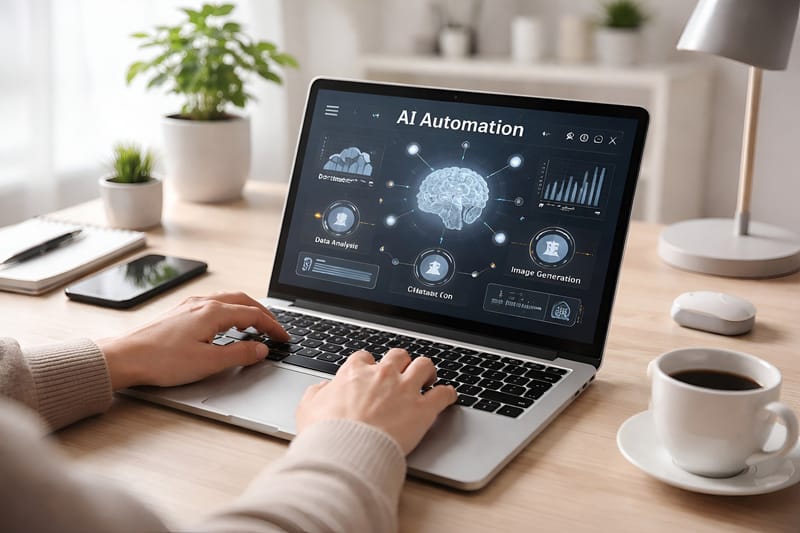
The Quiet Revolution: How Artificial Intelligence Has Reshaped Our World By Leonard Simolo| April 28, 2026 There is a particular kind of revolution that does not announce itself with gunfire or pageantry. It arrives softly — through a chatbot that schedules your dentist appointment, a recommendation engine that knows you better than your closest friends, a diagnostic tool that spots cancer cells that a tired radiologist might have missed at 2 a.m. Artificial intelligence is that revolution. And whether we noticed it happening or not, it has fundamentally changed the world we live in. From Science Fiction to Daily Life For decades, AI lived in the imagination — the all-knowing HAL 9000, the dystopian Skynet, the charming R2-D2. It was a story we told ourselves about the future. Then, almost without fanfare, the future arrived. Today, AI is not a concept housed in a laboratory or a Hollywood screenplay. It is the algorithm that flags a fraudulent transaction on your credit card before you even notice the charge. It is the voice that wakes you up, tells you the weather, and plays your morning playlist. It is the autocomplete on your phone, the spam filter in your inbox, and the navigation app that reroutes you around a traffic accident in real time. AI has moved from the extraordinary to the invisible — and that invisibility is, perhaps, its greatest achievement. Transforming Industries from the Inside Out Healthcare: A New Diagnostic Partner Few sectors have felt the impact of AI as profoundly as healthcare. Machine learning models can now analyze medical imaging — X-rays, MRIs, retinal scans — with a speed and accuracy that rivals, and in some cases surpasses, experienced specialists. Early detection of diseases like diabetic retinopathy, breast cancer, and Alzheimer's is no longer dependent solely on the availability of a skilled physician in the right place at the right time. Beyond diagnostics, AI is accelerating drug discovery. Processes that once took over a decade can now be compressed into months, with AI systems modeling protein structures and identifying candidate molecules at a scale no human team could replicate. The COVID-19 pandemic demonstrated this in real time: AI tools were central to understanding the virus and fast-tracking vaccine development. The result is a healthcare system that is slowly, imperfectly, but meaningfully becoming more proactive, more precise, and more accessible. Business and the Economy: Efficiency Reimagined In boardrooms and back offices alike, AI has become an indispensable strategic asset. Predictive analytics helps companies anticipate demand, manage supply chains, and personalize customer experiences at scale. In finance, algorithmic trading systems execute millions of transactions per second, while AI-powered risk models help banks and insurers make faster, smarter decisions. Customer service has been transformed by AI-powered chatbots and virtual assistants that handle routine inquiries around the clock, freeing human agents to focus on complex, high-value interactions. Recruitment, logistics, marketing — virtually every business function has been touched, optimized, and in some cases entirely reimagined through the lens of artificial intelligence. Education: Learning That Adapts to You The traditional one-size-fits-all classroom model has long been a subject of debate. AI is offering a compelling alternative. Intelligent tutoring systems now adapt in real time to a student's performance, adjusting the pace, difficulty, and style of instruction to suit individual learning needs. Language learning apps use AI to identify pronunciation errors and tailor vocabulary exercises. Students in remote or underserved communities can access high-quality, personalized instruction that was once the exclusive privilege of the well-funded few. The teacher is not replaced — far from it. But the teacher is now supported by tools that would have seemed magical a generation ago. Climate and Sustainability: Intelligence in Service of the Planet Perhaps the most consequential application of AI is in the fight against climate change. AI systems are optimizing energy grids, reducing waste in manufacturing, and helping scientists model climate patterns with unprecedented precision. In agriculture, machine learning is enabling precision farming — using data from sensors, satellites, and drones to help farmers use less water, fewer pesticides, and make smarter planting decisions. AI is helping us understand the planet's systems more deeply and respond to environmental challenges more effectively than ever before. The Human Question No honest account of AI's impact can ignore the tension at its core. For every problem AI solves, it raises new ones. Jobs and displacement. Automation has always disrupted labor markets, and AI is no different — only faster and broader in its reach. Roles that once seemed safe from automation — paralegal work, financial analysis, even elements of creative work — are being reshaped. The question is not whether disruption will happen, but whether our systems of education, policy, and social support will adapt quickly enough to help people transition. Bias and fairness. AI systems learn from data, and data reflects the world as it is — including its inequities. Facial recognition systems that perform worse on darker skin tones, hiring algorithms that replicate historical patterns of discrimination, predictive policing tools that reinforce existing biases — these are not hypothetical concerns. They are documented realities that demand urgent attention from developers, policymakers, and society at large. Privacy and autonomy. The same AI that personalizes your news feed also knows your habits, your fears, and your preferences with uncomfortable intimacy. The surveillance capabilities enabled by AI represent a genuine threat to individual privacy and civil liberties if left unchecked by robust legal frameworks and ethical guardrails. The question of trust. As AI systems take on more consequential decisions — in medicine, law, criminal justice — questions of accountability become critical. When an algorithm makes a mistake, who is responsible? How do we ensure that AI is working for people rather than against them? These are not reasons to fear AI. They are reasons to engage with it seriously, thoughtfully, and with democratic intentionality. A Tool Shaped by Human Hands It is tempting to speak of AI as if it were a force of nature — inevitable, autonomous, beyond our control. It is not. Every AI system is built by people, trained on data chosen by people, deployed in contexts defined by people, and governed by policies written by people. The choices we make about how to develop and use these systems are our choices, with consequences we will live with. The most important insight about AI is not what it can do — it is what we choose to do with it. The same technology that can diagnose disease can spread misinformation. The same system that can optimize a power grid can be used to surveil a population. Intelligence, artificial or otherwise, is morally neutral. Its impact is determined by the values, intentions, and accountability of those who wield it. Looking Forward We are still in the early chapters of the AI story. The tools we use today — impressive as they are — will likely seem rudimentary to future generations, much as early mobile phones seem to us now. Artificial General Intelligence, AI systems that can reason across domains with human-like flexibility, remains a subject of intense research and debate. The next decade will bring advances that we can scarcely predict. What we can predict is this: AI will continue to change the world. The question we must answer — as individuals, as institutions, and as a global community — is how we want that change to unfold. Do we want AI that amplifies human potential or displaces it? That makes opportunity more equitable or more concentrated? Does that strengthen democratic institutions or undermine them? These are not technical questions. They are human questions, and they demand human answers. The revolution is quiet. But what we do with it will be anything but. This post was written to inform and inspire thoughtful conversation about the role of artificial intelligence in our world. The views expressed are those of the author. Artificial Intelligence, Technology, Future of Work, Innovation, Society, Digital Transformation
Read More